





why we use plankton extract (dna repair enzymes)
What is Plankton Extract?
Plankton extract is a broad term encompassing a wide variety of bioactive compounds derived from marine microalgae. With approximately 5,000 known types of marine phytoplankton, the biodiversity of these organisms is vast. Consequently, this diversity offers countless possibilities for skincare applications. The specific function of plankton extracts depends on the species used, the extraction methods employed, and the post-processing techniques. By adjusting these properties, scientists can engineer extracts with different, targeted skin benefits.
From skin brightening to cellular repair, plankton extracts are known for their versatility. One of the most prominent uses of plankton extract in skincare is as a source of DNA repair enzymes. These enzymes help maintain the skin’s structural integrity by addressing DNA damage caused by environmental stressors like UV radiation and pollution, contributing to healthier, more resilient skin.
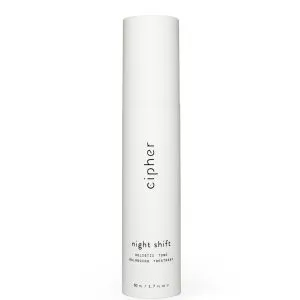
The Type of Plankton Extract in Night Shift
In Night Shift, our formula features a specialty DNA repair enzyme extraction derived from Haematococcus pluvialis and Chlorella vulgaris. These two nutrient-rich microalgae bring distinct benefits:
- Haematococcus pluvialis is a potent source of astaxanthin, one of the most powerful natural antioxidants, known for its ability to neutralise free radicals and inhibit tyrosinase activity, contributing to a more even skin tone.1
- Chlorella vulgaris is rich in carotenoids, which offer additional antioxidant protection, helping to defend the skin against oxidative stress and environmental damage.
DNA Repair Enzymes in Night Shift: How they Work
Our specialty DNA Enzyme extraction contains three critical enzymes: UV Damage Endonuclease (UVDE), Oxoguanine Glycosylase (OGG1), and Thioredoxin (TRX). Furthermore, these enzymes are encapsulated in a lecithin-based delivery system to enhance stability and ensure optimal skin penetration. Unlike many DNA repair enzymes that require UV light or cellular energy (ATP) to be activated, these enzymes are specifically designed to function while you sleep, providing peak activity during the skin’s natural nighttime repair process.2
- UVDE detects and repairs UV-induced DNA damage.
Ultraviolet (UV) radiation can cause DNA damage, notably forming cyclobutane pyrimidine dimers (CPDs), which disrupt normal cellular functions. UV damage endonuclease (UVDE) plays a crucial role in identifying and repairing CPDs. It employs a unique dual-dinucleotide flipping mechanism to recognise various DNA lesions, facilitating accurate repair and maintaining genomic stability.3 - OGG1 identifies and corrects oxidative DNA damage.
Oxidative stress leads to the formation of 8-oxo-dG (8-oxo-2'-deoxyguanosine) lesions in DNA, which can result in mutations if not corrected. OGG1 (8-oxoguanine DNA glycosylase 1) is essential for the base excision repair pathway, recognising and excising 8-oxo-dG to prevent mutagenesis. Topical application of OGG1 has been shown to influence UVB-induced skin carcinogenesis, highlighting its potential in skin cancer prevention.4 - TRX enhances the skin’s antioxidant defense by repairing oxidised proteins.
Thioredoxin (TRX) is a pivotal antioxidant protein that repairs oxidised proteins, thereby supporting overall cellular health. By maintaining the redox balance within cells, TRX enhances the skin's defense mechanisms against oxidative damage, contributing to improved skin resilience and function.5
Clinical Efficacy
Clinical studies conducted on the specialty DNA repair enzyme complex in Night Shift have demonstrated impressive results2:
- Keratinocyte repair more than doubled over 8 hours of sleep, showcasing the enzyme complex’s efficiency in cellular repair.
- Firmness improved by 16% within 28 days (p<0.001), as measured by skin Cutometer® readings.
- Wrinkle depth reduced by 15% within just 10 days (p<0.05), as demonstrated by profilometry analysis (PRIMOS).
- Visible improvements in skin radiance, firmness, and smoothness were reported in as little as ten days.
Plankton-derived DNA repair enzymes are an excellent solution for restoring skin health, promoting a vibrant complexion, and enhancing overall skin resilience.
references
- 1 Higuera-Ciapara, I., Félix-Valenzuela, L., & Goycoolea, F. M. (2006). Astaxanthin: A Review of its Chemistry and Applications. Critical Reviews in Food Science and Nutrition, 46(2), 185–196. doi: 10.1080/10408690590957188 Astaxanthin: A Review of its Chemistry and Applications.
- 2 ALGAKTIV®. (2018). GenoFix Nite Slides 201804. Retrieved from ALGAKTIV® proprietary data.
- 3 Meulenbroek EM, Peron Cane C, Jala I, Iwai S, Moolenaar GF, Goosen N, Pannu NS. UV damage endonuclease employs a novel dual-dinucleotide flipping mechanism to recognize different DNA lesions. Nucleic Acids Res. 2013 Jan;41(2):1363-71. doi: 10.1093/nar/gks1127. Epub 2012 Dec 4. PMID: 23221644; PMCID: PMC3553973. UV damage endonuclease employs a novel dual-dinucleotide flipping mechanism to recognize different DNA lesions.
- 4 Wulff BC, Schick JS, Thomas-Ahner JM, Kusewitt DF, Yarosh DB, Oberyszyn TM. Topical treatment with OGG1 enzyme affects UVB-induced skin carcinogenesis. Photochem Photobiol. 2008 Mar-Apr;84(2):317-21. doi: 10.1111/j.1751-1097.2007.00257.x. Epub 2007 Dec 17. PMID: 18086242. Topical treatment with OGG1 enzyme affects UVB-induced skin carcinogenesis.
- 5 Carpenter, E. L., Wyant, M. B., Indra, A., Ito, S., Wakamatsu, K., Merrill, G. F., Moos, P. J., Cassidy, P. B., Leachman, S. A., Ganguli-Indra, G., & Indra, A. K. (2022). Thioredoxin Reductase 1 Modulates Pigmentation and Photobiology of Murine Melanocytes in vivo. Journal of Investigative Dermatology. https://doi.org/10.1016/j.jid.2021.11.030 Thioredoxin Reductase 1 Modulates Pigmentation and Photobiology of Murine Melanocytes in vivo.
explore more

Hydroxypropyl Cyclodextrin
Hydroxypropyl cyclodextrin is skin-friendly, plant derived carbohydrate and skin conditioning agent. It helps keep skin soft and smooth…
read →
Hydroxypropyltrimonium Hyaluronate
Hydroxypropyltrimonium Hyaluronate is a cationic hyaluronic acid designed for long-lasting hydration and barrier support. Its positively charged structure…
read →
Tripeptide-29
Tripeptide-29 is a signalling peptide that supports the skin's collagen creation process. It helps soften the appearance of…
read →
Sodium Chondroitin Sulfate
Sodium chondroitin sulfate is a glycosaminoglycan that functions as a powerful humectant. Like its relative hyaluronic acid, it's…
read →
Panax Ginseng Root Oil
Panax Ginseng Root Oil is a highly bioactive essential oil that provides antioxidant protection, supports scalp health, supports…
read →
Tocopheryl Nicotinate
Tocopheryl Nicotinate combines the antioxidant benefits of Vitamin E with the circulation-enhancing effects of Vitamin B3, making it…
read →